



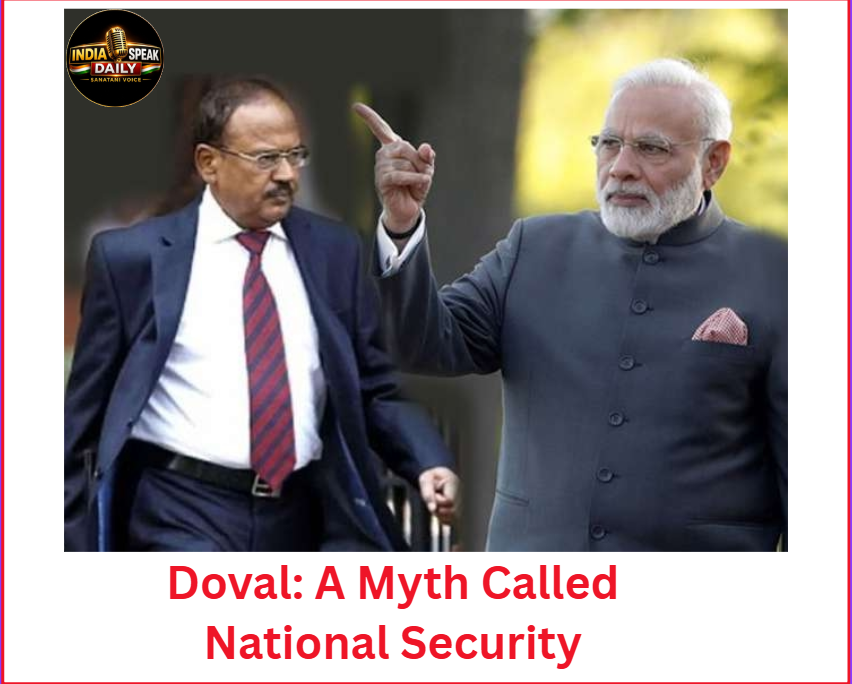

Power, networks, operations and the unresolved record of India’s National Security Adviser Ajit Doval is among the very few people to have the constant ear of Prime Minister Narendra Modi, a prime minister who has centralised power to an extent greater than any of his predecessors in recent decades. Appointed National Security Adviser (NSA) in May 2014, Doval has become perhaps the most prominent security bureaucrat in modern India, operating at the intersection of intelligence, national security, foreign policy and political power.
His supporters portray him as an exceptionally capable strategist, a master of covert operations and the architect of a more muscular Indian security posture. His critics see something very different: an intelligence operative whose operational instincts have been elevated into national strategy, a figure whose enormous influence has weakened institutional checks, and whose reputation has sometimes been built upon dramatic stories that are difficult to verify.
इस खोजी आलेख को हिंदी में पढ़ने के लिए क्लिक करें।
The question surrounding Doval is therefore larger than the man himself: has the extraordinary concentration of national-security authority around one individual strengthened India’s strategic position, or has it created a system in which image, decisiveness and retaliation have too often substituted for durable strategic outcomes?
More Read

I | “INDIA’S JAMES BOND”
Ajit Doval is India’s most powerful security bureaucrat.
Appointed by and answerable only to the prime minister, he heads the National Security Council, an advisory body that includes the ministers of home, finance, defence and external affairs.
Below the National Security Council sits the Strategic Policy Group. It includes the secretaries of the ministries represented on the council, the chiefs of India’s armed forces and the heads of its principal intelligence agencies — the Intelligence Bureau, or IB, and the Research and Analysis Wing, or RAW.
The National Security Adviser is responsible for planning and coordinating the government’s efforts to develop a coherent strategy for India’s protection, domestically and internationally. He also functions as the principal filter of security-related information and advice between government institutions and the prime minister, particularly in matters involving intelligence.
In addition, as chairperson of the executive council of the Nuclear Command Authority, the NSA recommends action concerning the control of India’s nuclear arsenal to the NCA’s ultimate authority: a political council chaired by the prime minister.
Those are the formal boundaries of Doval’s power.
The actual boundaries are considerably harder to establish.
The clandestine nature of intelligence and national-security work makes Doval’s precise influence difficult to measure, but people familiar with the inner workings of government have repeatedly argued that his authority extends beyond his formal responsibilities.
An analyst who worked with the NSA said Doval had immense influence over the home, defence and external-affairs ministries. A former member of the Cabinet Secretariat said Doval bypassed the formal command structures of India’s intelligence agencies and dealt directly with their operatives.
The same former official said Doval was one of Modi’s principal diplomatic counsellors, rivalled in that role primarily by the foreign secretary.
A Bloomberg report in 2016 went further, observing that “some consider Ajit Doval the most powerful person in India after Prime Minister Narendra Modi.”
From intelligence officer to national-security celebrity
Doval’s projected self-image has also extended beyond the formal constraints of the NSA’s office.
Between his retirement from the Intelligence Bureau in 2005 and his appointment as NSA in 2014, Doval became unusually outspoken for a retired intelligence officer.
He offered sweeping theories and hard-line solutions for some of India’s most complicated domestic and international problems. His commentary extended into areas such as minority politics that fell beyond the conventional remit of intelligence and national security.
Breaking the customary silence — the omertà — associated even with retired intelligence officers, Doval also disclosed remarkable details about his 33-year career in the Intelligence Bureau.
The result was a powerful public persona: part grand statesman, part strategist, part super-spy and part crisis manager — seemingly the perfect man to be trusted when national survival is at stake.
That image was reinforced by a media ecosystem, particularly national-security and defence correspondents, that repeatedly circulated larger-than-life accounts of Doval’s exploits during his Intelligence Bureau career.
Many of those stories are unverified and, in some cases, difficult or impossible to verify.
One description became so common that it hardened into cliché:
“India’s James Bond.”
Doval today has a higher media profile than any previous Indian NSA and is considerably more prominent than virtually every other bureaucrat in the government.
The critics’ case: Doval’s critics argue that the popular mythology surrounding him provides only a partial picture of his career and the events in which he participated.
Their argument is that his Intelligence Bureau background made him primarily an operations man — someone trained in espionage, intelligence collection and suppression — rather than a policymaker educated in the diplomatic and political compromises demanded by the NSA’s present role.
In diplomacy, critics say, accommodation can be as important as intimidation and subversion.
Doval’s hawkishness, in this interpretation, reflects that limitation: when the only tool available is a hammer, every problem begins to resemble a nail.
His record as NSA has therefore attracted increasing scrutiny.
The security situation in Kashmir has at various points become more volatile than it had been in decades, with militancy returning as a major challenge. India’s relationship with several immediate neighbours deteriorated after Doval assumed office in May 2014.
Even at the tactical level, questions have been raised. The response to the militant attack on the Pathankot Air Force Station, during which Doval directed operations, was described as inept by numerous experts.
The larger concern is straightforward: if the country’s most powerful security official is failing to anticipate or manage major security crises, the consequences extend far beyond the reputation of one bureaucrat.
Politics and power:
Doval’s political relationships have also played an important role in his career.
During his Intelligence Bureau years, he developed close links with the Bharatiya Janata Party and the Rashtriya Swayamsevak Sangh.
In the run-up to the 2014 general election, while he was in charge of an RSS-affiliated think tank, rumours circulated that Doval was assisting Narendra Modi’s campaign and working to weaken the incumbent government.
The precise details of his contribution have only gradually emerged.
What is less disputed is Doval’s subsequent loyalty to Modi.
Critics consider his unquestioning loyalty troubling in someone whose fundamental responsibility is to tell the prime minister difficult facts, including facts the prime minister may not wish to hear.
They also point to Doval’s statements and activities as evidence of an affinity with the belligerent Hindu nationalism associated with the RSS.
The fact that a figure with these convictions became India’s most celebrated NSA is itself significant, critics argue, because it reflects how widely similar political obsessions and prejudices have spread through sections of the Indian public.
Studying Doval’s conception of the Indian state, in this view, provides a window into how India’s current rulers and their supporters understand the state itself.
II | OPERATIONS
Little is known about Doval’s early years.
He was born in 1945 into a Brahmin family in Ghiri, a village in the hills of what is now Uttarakhand. His father was an Indian Army officer. His mother’s cousin was HN Bahuguna, the former chief minister of Uttar Pradesh and a Congress leader.
Doval attended Ajmer Military School in Rajasthan and later earned a degree in economics from the University of Agra.

In 1968, he joined the Indian Police Service as part of the Kerala cadre.
After training in Kottayam, he was appointed additional superintendent of police in Thalassery.
He was there when the town experienced notorious communal riots at the end of 1971 and beginning of 1972.
According to Alexander Jacob, a former director general of police of Kerala who wrote a report on the violence in 1989, Doval played an important role in controlling the riots.
By 1972, Doval had moved into the Intelligence Bureau and joined its operations wing.
Before retiring in 2005, he would eventually — although only briefly — become director of the organisation.
His Intelligence Bureau career coincided with several of independent India’s most important internal-security crises.
He left his mark on many of them, although critics argue that popular accounts often exaggerate the depth of his personal involvement.
A recurring pattern wherever Doval operated involved what some intelligence officers called “out-of-the-box” methods, a phrase that could sometimes function as a euphemism for extrajudicial practices.
Doval was not solely responsible for these methods. Indian intelligence agencies had resorted to such tactics long before he joined the IB.
But the operations also shaped Doval himself.
Operation Black Thunder and the mythology of the super-spy
One of the most frequently repeated stories concerns Doval’s alleged role in Operation Black Thunder II, the 1988 operation to remove Khalistani militants from the Golden Temple complex in Amritsar.

Operation Black Thunder II was conducted in May 1988 under Punjab Police chief KPS Gill.
Unlike the controversial 1984 Operation Bluestar, the authorities used a prolonged siege, intelligence gathering and negotiated pressure. The operation ultimately led to the militants’ surrender with substantially less damage and loss of life.
Contemporary accounts and later books written by officials directly involved in the operation — including Maloy Krishna Dhar and Sarabjit Singh — as well as journalists covering the siege, discuss intelligence activities but do not identify Ajit Doval as the central undercover operative.

Yet after Doval became a nationally prominent figure and later NSA, a dramatic version of his role became increasingly widespread.
According to these accounts, Doval:
* disguised himself as a rickshaw puller;
* posed as an agent of Pakistan’s Inter-Services Intelligence, or ISI;
* entered the Golden Temple complex;
* gathered intelligence from inside;
* and relayed critical information to Indian security forces during the operation.
Journalists including Yatish Yadav and Praveen Swami promoted versions of these stories, while retired NSG officer Karan Kharb claimed that Doval moved inside the complex despite active gunfire.
But several eyewitness journalists who were present during the siege expressed serious doubts.

They said they never saw Doval inside the complex and questioned how a senior intelligence officer could have entered, maintained a false identity and communicated intelligence without attracting suspicion.
A former Intelligence Bureau official also challenged the account, explaining that normal intelligence procedures would not ordinarily require a senior officer such as a Joint Director to personally infiltrate militants. Such missions would normally be assigned to lower-ranking operatives or trusted insiders.
The conclusion is therefore necessarily qualified.
Doval almost certainly contributed to Punjab’s counterinsurgency effort and Intelligence Bureau operations. But the extent of his personal role in Operation Black Thunder remains unclear and disputed.
The larger success against Khalistani militancy is generally attributed to the collective efforts of KPS Gill, Julio Ribeiro, the Punjab Police and intelligence agencies.
The Black Thunder story nevertheless became an important part of Doval’s mythology.
Repeated retellings transformed a complicated institutional counterinsurgency operation into a story centred on a single heroic intelligence officer.
The Pakistan years:
There is similarly little independently verifiable information about Doval’s alleged stint in Pakistan.
Numerous journalists have filled the gap with stories, as has Doval himself.
The absence of accessible evidence has allowed the legend to grow around the facts.
This is a recurring feature of the Doval narrative: the less available the documentary record, the more room there is for dramatic accounts of espionage, infiltration and strategic brilliance.
That mythology has become a political asset in itself.
III | THE DOVAL DOCTRINE AND A DECADE OF NATIONAL SECURITY
The central question today is whether Doval’s public reputation as an extraordinary security strategist corresponds to India’s strategic record during his more than decade-long tenure.
A discussion by The Caravan, involving executive editor Hartosh Singh Bal and consulting editor Sushant Singh, examined precisely this question.

The discussion argued that national-security decision-making has become unusually concentrated around Doval and that his influence extends beyond the conventional responsibilities of an NSA into areas traditionally associated with the Ministry of External Affairs.
The speakers questioned whether the so-called “Doval Doctrine” — an assertive, muscular approach to national security, particularly concerning Pakistan, Kashmir and other security challenges — has consistently translated toughness into strategic advantage.

Security failures under scrutiny
The criticism is not limited to one incident.
Major terrorist attacks, including Pulwama and Pahalgam, have raised questions about India’s intelligence and security architecture.
The continuing difficulties along the Line of Actual Control with China have generated another set of questions.
The fundamental issue is whether the reputation of Doval as an exceptionally capable strategist has obscured the need to examine failures within the institutions for which he bears ultimate responsibility.
If national-security decisions are increasingly concentrated in a small group around the NSA, then the success or failure of those institutions cannot simply be measured by the appearance of decisiveness.
They must be measured by outcomes:
* Were attacks prevented?
* Were threats identified early?
* Were borders effectively managed?
* Were intelligence capabilities strengthened?
* Was India’s strategic position improved?
* Were durable political settlements created?
China: deterrence, confrontation and the 2020 crisis
The biggest challenge to Doval’s record is arguably China.
The 2020 Ladakh crisis produced the most serious deterioration in the India-China security relationship in decades.
Chinese forces occupied or blocked access to areas along the Line of Actual Control, culminating in the deadly Galwan clash and a prolonged military confrontation.
The fact that such a major mobilisation occurred despite India’s extensive intelligence, surveillance and military capabilities raises questions about strategic anticipation and preparedness.
Doval’s role is not simply to respond once a crisis has begun. One of the central responsibilities of the NSA is to anticipate strategic threats and coordinate the security apparatus accordingly.
The criticism, therefore, is not simply that China acted aggressively.
It is that India’s national-security system did not adequately anticipate or deter China’s willingness to alter the status quo along the LAC.
From deterrence to crisis management
The distinction between deterring China and managing the consequences of Chinese actions is central.
After 2020, India deployed enormous military resources along the China border and entered prolonged negotiations over disengagement in several areas.
Those measures helped stabilise the immediate situation.
But they also demonstrated that India’s original objective — preventing China from changing the situation on the ground — had not been achieved.
India’s China policy consequently became reactive as much as proactive.
The contradiction has become particularly visible as India and China have resumed efforts to normalise relations.
In June 2026, Doval himself emphasised the need for stable and predictable bilateral relations and sensitivity to each other’s “core concerns.”
That raises an uncomfortable question for the Doval doctrine:
If military pressure and strategic confrontation were supposed to force China to respect India’s interests, why has India ultimately had to return to intensive diplomacy and confidence-building?
The 25th round of Special Representatives’ talks in Beijing in August 2026 illustrates the same point: diplomacy remains indispensable despite years of confrontation.
China and Pakistan: one strategic problem or two?
A second weakness concerns the increasingly close China-Pakistan relationship.
China has become Pakistan’s principal defence supplier and has developed extensive military, technological and economic ties with Islamabad.
The relationship has moved beyond a conventional arms-supplier arrangement toward deeper defence-industrial integration.
This creates the possibility of a two-front security challenge for India.
Any sustainable China strategy must therefore account simultaneously for:
* the LAC dispute;
* Chinese military infrastructure in India’s neighbourhood;
* Chinese military support for Pakistan;
* CPEC and Chinese activity in Pakistan-occupied Kashmir;
* Chinese access to the Indian Ocean;
* and the possibility of coordinated Chinese and Pakistani pressure during an India-Pakistan crisis.
The criticism of Doval’s approach is that China and Pakistan have often been treated as separate security problems when, strategically, their interests are increasingly interconnected.
Pakistan: tactical success, strategic uncertainty
Doval’s Pakistan policy is frequently presented as one of his greatest successes.
India moved away from a largely defensive posture toward what became known as a “defensive-offensive” approach.
The 2016 surgical strikes and 2019 Balakot operation became important symbols of this policy.
The objective was to impose costs on Pakistan rather than simply absorb attacks.
But tactical retaliation is not the same as strategic resolution.
The deeper question is whether these operations fundamentally changed Pakistan’s long-term behaviour.
Pakistan remains a major military power with nuclear deterrence and a close strategic relationship with China.
India and Pakistan remain trapped in a cycle in which terrorism, military retaliation and escalation repeatedly threaten regional stability.
The criticism is therefore not necessarily that the military responses were unjustified.
It is that retaliation should not be confused with strategic success.
Did pressure on Pakistan strengthen the China-Pakistan axis?
An important potential unintended consequence of sustained India-Pakistan confrontation is Pakistan’s growing dependence on China.
China has supplied Pakistan with aircraft, missiles, naval systems and other military technologies.
CPEC has simultaneously given Beijing an enormous economic and strategic stake in Pakistan.
In 2025, Pakistan announced major prospective Chinese defence purchases, including J-35 aircraft and other advanced systems.
The result is a difficult strategic paradox.
India’s pressure on Pakistan does not necessarily isolate Pakistan.
It may instead deepen Islamabad’s reliance on Beijing.
The objective of national security cannot simply be to punish Pakistan after an attack. India must also prevent a situation in which Pakistan becomes increasingly dependent on China militarily while China simultaneously confronts India along the Himalayan border.
CPEC and Pakistan-occupied Kashmir
Doval has publicly challenged China’s activities in Pakistan-occupied Kashmir.
At the 2023 Shanghai Cooperation Organisation meeting, he criticised connectivity projects that did not respect sovereignty, a position directly relevant to the China-Pakistan Economic Corridor.
Yet the problem remains unresolved.
CPEC continues to develop, while Beijing and Islamabad continue to describe their relationship as exceptionally close.
Pakistan and China reaffirmed their commitment to expanding CPEC and broader defence and security cooperation in January 2026.
India can object diplomatically to CPEC, but the larger problem is that China has acquired substantial economic, infrastructural and military influence in territory that India claims.
This demonstrates a gap between India’s stated position and its ability to materially alter Chinese behaviour.
The problem of leverage
India has repeatedly made clear that Chinese military activity and CPEC-related projects in Pakistan-occupied Kashmir are unacceptable.
Yet China remains Pakistan’s principal strategic partner.
At the same time, India cannot afford to maintain permanently hostile relations with Beijing.
India needs China economically and diplomatically while preparing for China militarily.
A successful national-security strategy must therefore create leverage that allows India to manage this contradiction.
The criticism of the Doval period is that India has frequently found itself reacting to Chinese initiatives rather than consistently shaping Beijing’s calculations.
Beyond military power
China’s power does not derive solely from military strength.
Its advantages extend into:
* manufacturing;
* critical minerals;
* infrastructure;
* telecommunications;
* supply chains;
* advanced technology;
* defence production;
* and economic influence.
China’s restrictions on rare-earth materials have highlighted India’s vulnerability in critical supply chains.
A national-security doctrine heavily focused on military deterrence can therefore overlook the broader contest.
India’s China strategy requires simultaneous progress in manufacturing, semiconductors, critical minerals, defence-industrial production, infrastructure, maritime power, intelligence, cyber capabilities, technology and economic resilience.
Military signalling cannot substitute for comprehensive national power.
IV | KASHMIR AND THE POLITICS OF SECURITY
Kashmir is another major component of the criticism directed at Doval.
The government has pursued a security-first approach associated closely with his tenure, relying extensively on administrative and security measures.
The broader question is whether a strategy centred primarily on control and deterrence can produce lasting political stability.
The absence or suppression of immediate dissent cannot be the sole measure of success.
A sustainable security policy must also produce durable political legitimacy and stability.
This is one of the fundamental criticisms of a heavily centralised security doctrine: control may produce temporary order without resolving the political causes of instability.
V | THE CONCENTRATION OF POWER
The most significant institutional criticism of Doval is not necessarily about any single decision.
It concerns the concentration of authority itself.
Doval has occupied the position of National Security Adviser for more than a decade and, according to critics, accumulated an unusually large degree of influence over India’s security and foreign-policy establishment.
This makes institutional accountability especially important.
Foreign policy and national security benefit from competing assessments.
China policy, for example, requires diplomats, military planners, intelligence officers, economists and regional specialists to challenge assumptions and provide alternative analyses.
If decision-making becomes concentrated within a small circle, groupthink becomes a danger.
That danger is particularly serious when the prevailing strategy places a premium on confidence, deterrence, retaliation and demonstrations of resolve.
The question is therefore not simply whether Doval personally made one particular decision.
The question is whether India’s national-security architecture under his influence has retained enough institutional disagreement and independent assessment to correct mistakes.
VI | THE ANNA MOVEMENT, VIF AND THE POLITICAL ECOSYSTEM
To understand the ecosystem around the Anna movement and the political world that eventually produced the Modi-era establishment, it is useful to follow money, institutions and relationships rather than treating every episode as an isolated coincidence.
One important institution is the Vivekananda International Foundation (VIF).
Founded in 2009, VIF was headed by Ajit Doval. Contemporary reporting linked the organisation to the coming together of figures such as Anna Hazare, Arvind Kejriwal, Kiran Bedi and Baba Ramdev around the 2011–12 anti-corruption mobilisation.
VIF itself published sympathetic material about Anna’s movement.
Then comes the money.
VIF’s 2012 material, as reflected in documents circulated with the account, records a ₹60 lakh donation from the Neotia Foundation for its Research Resource Centre & Library.
That is significant institutional funding.
But an important distinction must be maintained: the material cited does not establish that the ₹60 lakh was specifically earmarked to finance the Anna protests.
What it establishes is financial support for an institution that was simultaneously providing intellectual and organisational space around the anti-corruption movement.
The Neotia connection
The Neotia connection then leads into another institutional network.
A Neotia became a trustee of the Shree Somnath Trust alongside Narendra Modi, L.K. Advani and, later, Amit Shah.

This placed the Neotia family within an institutional circle that has included some of the BJP’s most powerful figures.
The simplistic conclusion — “Neotia funded Anna, therefore Modi funded Anna” — goes beyond the evidence.
The more demonstrable story is about an ecosystem.
A think tank led by Doval developed ideological and institutional links around the anti-corruption movement.

A prominent business family provided substantial institutional funding to that think tank.
The same business family maintained a longstanding institutional relationship with Modi through the Somnath Trust.
And after the BJP’s victory in West Bengal in 2026, Neotia publicly welcomed the result, saying that having the same political party governing the state and Centre created an opportunity for “greater alignment” in priorities and execution and could accelerate infrastructure development and improve the ease of doing business.

None of this establishes a secret command structure.
It does not need to.
It demonstrates how money, think tanks, ideological networks, elite institutions and political power can intersect over decades, while each individual relationship remains perfectly respectable when examined in isolation.
That is why the history of the Anna movement merits examination not only as a spontaneous uprising against corruption but also as part of the wider institutional ecosystem surrounding the politics that followed.
VII | MODI AND DOVAL
How Doval’s path converged with Modi’s
Doval helped build the ecosystem that aided Modi’s political rise; Modi, once in power, elevated Doval to NSA and gave him an extraordinary degree of direct and unfettered access to the Prime Minister—turning a former intelligence operative into one of the most powerful officials in the government.

The claim is essentially that Doval’s political usefulness, ideological alignment and strategic value helped produce a relationship in which the NSA became one of Modi’s most trusted advisers.
The significance of this relationship lies in the fact that the NSA is supposed to provide independent security advice, including information that may be politically inconvenient.
When personal loyalty and institutional authority become closely intertwined, critics argue, the possibility of independent advice becomes more difficult to assess.
VIII | THE SANGH, THINK TANKS AND THE STATE
Despite not being registered as a political organisation in India, the RSS has exercised substantial influence over India’s political and intellectual ecosystem.
One important mechanism is the movement of personnel through Sangh-inspired or Sangh-associated think tanks and institutions.

Prominent figures associated with this broader ecosystem include Ajit Doval, Brijesh Mishra, Ram Madhav and S. Gurumurthy.
Over the years, critics have argued that this network has influenced education policy, defence policy, economic policy and broader Indian civil society.
They point to the presence of individuals linked to the Sangh in senior positions at universities, educational institutions, courts and government bodies, while arguing that sections of the media have gradually become more sympathetic to or influenced by Sangh-aligned interests.
But the evidence requires an important distinction.
There is a documented network connection.
That does not establish that every institution within the network is formally controlled by the RSS.
IX | VIF AND INDIA FOUNDATION
The relationship can be understood more accurately as two overlapping institutional nodes.
Ajit Doval and VIF
Ajit Doval became the founding director of the Vivekananda International Foundation when it was established in 2009 under the aegis of Vivekananda Kendra.

VIF itself describes this institutional parentage and has listed Doval among its board or trustee members, although he has been on long leave because of his government position.
VIF describes itself as independent and non-partisan.

However, reporting has documented close personal and ideological links between VIF and the broader RSS ecosystem.
One particularly important figure is S. Gurumurthy, an RSS-associated intellectual who was an important force behind VIF’s creation and who has been described as connecting the institution emotionally and intellectually to the Sangh Parivar.
Shaurya Doval and India Foundation
Around the same period, Doval’s son Shaurya Doval became a director of the India Foundation, a separate think tank.
One of his important collaborators was Ram Madhav, then a national spokesperson for the RSS and subsequently a BJP general secretary.
India Foundation’s leadership has included people holding prominent BJP and government positions alongside Shaurya Doval and Ram Madhav.
The Economic Times described the organisation as heavily populated by BJP/RSS figures and positioned Shaurya Doval as a participant in policy discussions surrounding the Modi government.
The important conclusion is therefore not that “Ajit’s foundation controls his son’s foundation.”
There is insufficient evidence for such a claim.
The more accurate description is that the two organisations represent overlapping nodes in a broader intellectual and political network.
# X | THE NETWORK
The architecture can be represented as follows:
RSS / Sangh Parivar
↓
S. Gurumurthy — Ram Madhav — Dattatreya Hosabale
↓ ↓
VIF India Foundation
↓ ↓

Ajit Doval Shaurya Doval
↓ ↓
National-security Policy and political
and strategic convening network
establishment
The two networks overlap through people, institutions, events and the Doval family.
There are two especially important bridges.
S. Gurumurthy links VIF directly into the Sangh’s economic and intellectual ecosystem.
Ram Madhav links India Foundation directly to both the RSS and the BJP.

The Doval family provides another institutional bridge: Ajit Doval was VIF’s founding director, while his son Shaurya became associated with India Foundation.
That is a real personal and institutional connection, but it should not be overstated as evidence of common ownership or command.
XI | S. GURUMURTHY — THE SANGH BRIDGE
Among all the connections, S. Gurumurthy is one of the clearest.
He is a founder of VIF and its current chairman of the board of trustees.
He is also co-convenor of the Swadeshi Jagaran Manch, editor of Thuglak and a prominent economic commentator.
The Swadeshi Jagaran Manch describes itself as an affiliate of the RSS and identifies Gurumurthy as a co-convenor.
Independent reporting has similarly described Gurumurthy as associated with the RSS-affiliated organisation.
The resulting chain is therefore straightforward:

RSS-affiliated SJM → S. Gurumurthy → VIF
That is not merely speculation.
Gurumurthy’s significance extends beyond VIF. He has been an influential voice on economic policy during the Modi era and was appointed to the Reserve Bank of India’s central board in 2018.
It is therefore reasonable to describe Gurumurthy as a Sangh intellectual or Sangh-associated intellectual.
It is not, however, reasonable to infer automatically that every position taken by VIF represents an RSS position.
XII | SHAURYA DOVAL AND INDIA FOUNDATION
Shaurya Doval was an early director of India Foundation.
A 2014 India Foundation journal listed him as editor, while an India Foundation report from the same year identified him as a director.

He has also served on its governing council.
The family parallel is striking:
Ajit Doval → VIF
Shaurya Doval → India Foundation
That is a documented institutional relationship rather than something inferred merely from their surname.
But again, the evidence does not establish that Ajit Doval controls India Foundation through his son.
The more defensible interpretation is that the Doval family became associated with two influential policy institutions operating within overlapping Delhi policy networks.
XIII | RAM MADHAV — RSS, BJP AND INDIA FOUNDATION
If one person reveals the Sangh relationship most clearly, it is arguably Ram Madhav.
Madhav was a full-time RSS pracharak and spokesperson before moving into the BJP.

He later became BJP national general secretary from 2014 to 2020.
At India Foundation, he became a founding member of its Governing Council and is identified as its president.
The chain is therefore explicit:
RSS → Ram Madhav → BJP → India Foundation
These are documented institutional positions.
India Foundation’s events provide further evidence of the relationship.
At its 2023 symposium on “India’s Nationalist Traditions,” RSS Sarkaryavah Dattatreya Hosabale delivered introductory and closing remarks and presided over sessions, while Ram Madhav moderated them.
That is strong evidence of institutional interaction with the Sangh, even though it does not establish that India Foundation is formally an RSS organisation.
XIV | SURESH PRABHU
Suresh Prabhu represents a somewhat different case.
He has served as chairman of India Foundation’s Governing Council.
India Foundation records identify him as a former Union minister and chairman of its governing council. He has chaired major India Foundation events, including the Indian Ocean Conference and the Atal Bihari Vajpayee Memorial Lecture.
An India Foundation report from 2014 identified Suresh Prabhu, Ram Madhav and Shaurya Doval together as India Foundation directors during a delegation to China.
His significance is therefore best understood as representing the political and governmental establishment intersecting with the India Foundation policy network.
Unlike Madhav or Gurumurthy, however, the available evidence does not establish Prabhu as an RSS organisational functionary.
Thus:
Prabhu → India Foundation → Sangh-linked personnel is documented. But: Prabhu → RSS
is a much stronger claim and cannot be established simply from his India Foundation role.
# XV | NIRMALA SITHARAMAN
Nirmala Sitharaman presents a similar distinction between institutional association and RSS affiliation.
The 2017 Caravan investigation identified Sitharaman as one of the directors of India Foundation alongside Shaurya Doval, Suresh Prabhu and Ram Madhav.
India Foundation has continued to provide a platform for her. In March 2025, for example, she delivered its Budget briefing, chaired by Shaurya Doval.
The strongest conclusion is therefore:
Union minister ↔️ India Foundation policy network
rather than:
Sitharaman → RSS
There is insufficient evidence in this material to classify Sitharaman as an RSS organisational figure.
XVI | THE REVEALING 2014 SNAPSHOT
One particularly useful piece of evidence is India Foundation’s own account of its 2014 delegation to China.
It listed:
Ram Madhav — BJP general secretary / India Foundation director;
Suresh Prabhu — former Union minister / India Foundation director;
Shaurya Doval — India Foundation director;
and other policy and security figures.
The delegation occurred shortly after the Modi government came to power.
The 2014 India Foundation journal also listed Shaurya Doval as editor while expressing optimism about the newly elected Modi government and stating that the Foundation was committed to helping the nation.
This does not prove that India Foundation was a BJP front.
It does show that the organisation was deeply embedded in the emerging Modi-era policy network.
XVII | THE VIF SIDE
VIF developed a somewhat different composition.
Its leadership has historically included:
Ajit Doval — security establishment;
S. Gurumurthy — Sangh-associated economic and intellectual figure;
Satish Chandra — senior diplomat;
General N. C. Vij — former Army chief;
Arvind Gupta — former Deputy NSA; and other diplomats and military and security officials.
VIF therefore developed a distinctive mixture:
Sangh intellectuals + former security officials + diplomats + strategic-policy specialists.
India Foundation’s network has been broader:
RSS/BJP politicians + ministers + diplomats + military officials + academics + business figures + international-policy networks.
XVIII | THE RSS–INDIA FOUNDATION RELATIONSHIP
The relationship between RSS and India Foundation is stronger than merely saying that RSS members occasionally attended its events.
India Foundation’s 2018 Young Thinkers Meet featured Ram Madhav, a governing-council member of India Foundation, alongside Krishnagopal, Joint General Secretary of the RSS, with discussions concerning ideology, leadership and Indian civilisational traditions.
In 2023, Dattatreya Hosabale, the RSS’s senior organisational leader, played a major role in an India Foundation symposium on Indian nationalism.
Such events make it difficult to describe the relationship merely as occasional networking.
At the same time, they do not by themselves prove formal organisational control.
XIX | THREE LEVELS OF CONNECTION
Claims about these institutions become clearer when three different forms of connection are distinguished.
Level One: Formal organisational connections
Examples include:
Ram Madhav: RSS → BJP → India Foundation;
S. Gurumurthy: Swadeshi Jagaran Manch → VIF;
Ajit Doval: VIF;
Shaurya Doval: India Foundation.
These are factual institutional affiliations.
Level Two: Personnel and network overlap
This is also strongly documented.
Examples include:
* RSS leaders appearing at India Foundation programmes;
* BJP ministers serving on or participating in India Foundation;
* security officials and diplomats appearing at VIF;
* common conferences, delegations and policy discussions.
This demonstrates a network, but not necessarily organisational control.
Level Three: Ideological influence or control
This is where considerably more caution is required.
It is reasonable to say:
VIF and India Foundation operate within an intellectual and personnel ecosystem that overlaps significantly with the Sangh Parivar and BJP.
It is not established merely by these facts that:
“The RSS runs VIF and India Foundation.”
That substantially stronger claim would require evidence of funding, ownership, instructions, appointments or formal organisational control.
# XX | THE DOVAL FAMILY CONNECTION
The Doval connection should therefore be separated from the RSS connection.
Doval family
Ajit Doval → VIF and Shaurya Doval → India Foundation This is a family and institutional bridge.
Sangh connection
S. Gurumurthy → SJM/RSS ecosystem → VIF and
Ram Madhav → RSS → BJP → India Foundation
This is a much more direct organisational and political bridge. Government connection
India Foundation → ministers such as Sitharaman and Prabhu and VIF → national-security officials, diplomats and military figures
These create a third layer: access to the state.
Taken together, the network looks less like a conventional think-tank ecosystem and more like a policy-intellectual ecosystem surrounding the BJP-era state, with substantial Sangh participation.
That remains an interpretation of documented relationships, not evidence that all the institutions are secretly controlled by one organisation.
XXI | THE INDIVIDUAL LINKS
The most important correction to a simplistic version of the story is therefore this:
It is not really: “Ajit Doval’s VIF → his son’s India Foundation → RSS.” It is closer to:
VIF → Ajit Doval → S. Gurumurthy → SJM/Sangh intellectual ecosystem → security and diplomatic establishment while:
India Foundation → Shaurya Doval → Ram Madhav → RSS → BJP → ministers, diplomats, business and policy networks
The two networks overlap through people, events and the Doval family.
That is the more evidence-based way to describe the architecture without turning documented associations into an unsupported claim of organisational control.
Muslim Rashtriya Manch (MRM): Ajit Doval’s engagement with the Muslim Rashtriya Manch (MRM) reveals a calculated fusion of national security rhetoric, selective Muslim outreach and Sangh expansion. The approach predates his tenure as NSA. In 2014 he framed Indian Muslims as useful partners against terrorism, citing religious leaders’ rejection of ISIS and al-Qaeda and families’ willingness to report radicalisation—an early signal that only compliant sections of the community would be treated as assets.
The MRM, an RSS-inspired outfit, has worked to manufacture a Muslim constituency inside the Sangh ecosystem. In 2019 it planned to collaborate with the BJP’s minority cell, campaign for Narendra Modi and endorse the Ram temple at Ayodhya. Engagement with such a body therefore supplies Doval with Muslim interlocutors already aligned with RSS/BJP priorities, while giving the Sangh a ready-made channel into parts of the community that can be presented as “outreach.”
XXII | DOVAL’S PERFORMANCE: CHINA AND PAKISTAN
Ajit Doval’s tenure has been associated with a more assertive and security-driven approach to foreign policy.
Supporters credit him with giving India greater willingness to use military and covert capabilities, particularly against Pakistan.
But the record also raises serious questions about whether assertiveness has translated into durable strategic gains.
The most significant concerns arise in India’s relationships with China and Pakistan.
1. China: failure to prevent deterioration
The most serious criticism is that India failed to prevent the deterioration in its border relationship with China.
The 2020 Ladakh crisis fundamentally changed bilateral relations.
Chinese forces occupied or blocked access to areas along the LAC, resulting in the Galwan clash and a prolonged military confrontation.
The fact that such a major mobilisation occurred despite India’s intelligence and surveillance capabilities raises questions about anticipation and preparedness.
As NSA, Doval’s institutional responsibility is not merely to respond after crises occur.
It includes anticipating threats.
The criticism is therefore that India’s national-security system failed to adequately anticipate or deter China’s willingness to alter the status quo.
2. From deterrence to prolonged crisis management
After 2020, India deployed enormous military resources to the China border and subsequently negotiated disengagement in several areas.
Those measures helped stabilise the situation.
But they also demonstrated that the initial objective — preventing China from changing the situation on the ground — had not been achieved.
India therefore moved from deterrence toward prolonged crisis management.
The return to diplomacy is particularly significant.
In June 2026, Doval emphasised the importance of stable and predictable relations and sensitivity to each other’s “core concerns.”
That raises the question of whether the doctrine of confrontation and deterrence ultimately produced the strategic leverage its advocates claimed.
3. China-Pakistan interdependence
China cannot realistically be treated as completely separate from Pakistan.
China has become Pakistan’s principal defence supplier and has developed extensive military, technological and economic ties with Islamabad.
The relationship has evolved into deeper defence-industrial integration.
India therefore faces a possible two-front challenge.
Its strategy must account for the LAC, China’s military infrastructure around India’s neighbourhood, Chinese support for Pakistan, CPEC, Chinese activity in Pakistan-occupied Kashmir, Chinese access to the Indian Ocean and the possibility of coordinated Chinese and Pakistani pressure during a crisis.
The criticism is that India’s strategy has sometimes treated China and Pakistan as separate problems even as the two become increasingly interconnected.
4. Pakistan: tactical success without strategic resolution
The Doval approach to Pakistan produced genuine tactical changes.
The 2016 surgical strikes and 2019 Balakot operation demonstrated India’s willingness to retaliate militarily.
But whether they altered Pakistan’s long-term strategic behaviour is another question.
Pakistan remains a substantial military power with nuclear deterrence and a close relationship with China.
Terrorism, retaliation and escalation remain recurring features of the relationship.
The distinction is therefore essential:
tactical retaliation is not necessarily strategic resolution.
5. The China-Pakistan axis
India’s sustained pressure on Pakistan may also have reinforced Islamabad’s dependence on Beijing.
China supplies Pakistan with aircraft, missiles, naval systems and other military technology.
CPEC has created a major Chinese economic and strategic stake in Pakistan.
In 2025, Pakistan announced prospective Chinese defence purchases including J-35 aircraft and other advanced systems.
India’s challenge is consequently not merely Pakistan.
It is Pakistan increasingly integrated into a Chinese strategic system.
6. CPEC and Pakistan-occupied Kashmir
Doval has publicly criticised Chinese connectivity projects that do not respect Indian sovereignty.
Yet CPEC continues.
China and Pakistan reaffirmed their commitment to expanding CPEC and defence cooperation in January 2026.
India’s stated opposition therefore has not materially altered China’s strategic presence in Pakistan-occupied Kashmir.
This is another example of the gap between diplomatic messaging and strategic leverage.
7. Limited leverage over Beijing
India has repeatedly stated that Chinese military activity and CPEC projects in Pakistan-occupied Kashmir are unacceptable.
Yet China remains Pakistan’s principal strategic partner.
India also cannot afford permanent hostility with Beijing.
The country therefore needs China economically and diplomatically while preparing for China militarily.
The criticism of the Doval period is that India has often reacted to Chinese initiatives rather than consistently shaping Chinese calculations.
8. The economic and technological dimension
The China competition extends beyond military power.
China dominates important areas including manufacturing, critical minerals, infrastructure, telecommunications, supply chains and technology.
Restrictions on rare-earth materials have highlighted India’s vulnerabilities.
A national-security strategy centred primarily on military deterrence therefore risks overlooking the wider contest.
India needs simultaneous progress in:
* manufacturing;
* semiconductors;
* critical minerals;
* defence production;
* infrastructure;
* maritime power;
* intelligence;
* cyber capabilities;
* technology;
* and economic resilience.
Military signalling cannot substitute for comprehensive national power.
XXIII | THE LARGER QUESTION: ACCOUNTABILITY
The central issue is accountability.
Doval has occupied the NSA position for more than a decade and, according to his critics, accumulated extraordinary influence over India’s security and foreign-policy establishment.
The greater the concentration of authority, the more important institutional checks become.
National security requires disagreement.
Foreign policy requires competing assessments.
China policy requires diplomats, military planners, intelligence officers, economists and regional experts to challenge assumptions.
A system concentrated around one individual risks groupthink.
This becomes particularly dangerous when the governing doctrine values toughness, deterrence, retaliation and public demonstrations of resolve.
The problem is therefore not simply whether Doval made a particular mistake.
It is whether the institutional architecture around him permits enough independent scrutiny to detect and correct mistakes.
XXIV | THE CENTRAL PARADOX OF THE DOVAL ERA
The strongest criticism of Doval’s record ultimately rests on the distinction between actions and outcomes.
India has demonstrated greater willingness to retaliate against Pakistan.
India has demonstrated military resolve against China.
India has increased its military deployments along the LAC.
India has publicly opposed CPEC.
But the strategic problems remain.
China remains India’s principal military competitor.
China maintains a close relationship with Pakistan.
Pakistan remains heavily dependent on Chinese military technology.
The LAC remains unresolved.
CPEC continues despite India’s objections.
India has had to return to high-level diplomatic engagement with Beijing.
And Doval remains directly involved in the negotiations.
The paradox is therefore stark:
India has become more assertive militarily, yet the two-front strategic challenge may have become more complicated rather than less.
XXV | “DHURANDHAR DOVAL”
The mythology surrounding Doval has now reached popular culture.
In Dhurandhar, the satirical portrayal turns Ajit Doval into something more than a National Security Adviser.
He becomes the supposed secret ingredient of Indian statecraft itself — a one-man intelligence agency, geopolitical chess grandmaster and omniscient shadow operative rolled into one.
At that rate, the joke goes, Doval does not need satellites; the satellites need Doval.
Every geopolitical crisis appears to begin and end with a mysterious nod from him.
The satire raises an obvious question: is the film a spy thriller, or an extended tribute video with explosions?
The humour works because it exaggerates an existing public mythology.
The real-world Doval has already been turned into a near-mythical figure through decades of stories about covert operations, infiltration, intelligence triumphs and decisive interventions. The problem is that mythology can obscure accountability.
XXVI | THE FINAL QUESTION
The fairest assessment of Ajit Doval is not that he has been uniformly unsuccessful. His approach produced genuine tactical changes in India’s willingness to respond to Pakistan and helped institutionalise a more assertive national-security posture.
The more serious question is whether those tactical successes have produced the strategic outcomes promised by the Doval doctrine.
On China, the 2020 crisis exposed shortcomings in anticipation and deterrence, followed by years of military deployment, negotiation and disengagement.
On Pakistan, India’s retaliatory capabilities have increased, but Pakistan’s strategic relationship with China has simultaneously deepened.
On Kashmir, a security-first approach has strengthened state control but leaves open the larger question of durable political stability and legitimacy.
At the institutional level, the concentration of power around the NSA raises questions about whether competing voices, independent intelligence assessments and diplomatic expertise receive sufficient weight.
And at the political level, Doval’s connections to the VIF, the wider Sangh intellectual ecosystem and the Modi establishment reveal a network in which think tanks, security officials, political figures, business interests and ideological organisations have intersected over decades.
The evidence supports substantial overlap between these networks. It does not, by itself, prove that VIF or India Foundation is formally controlled by the RSS, nor does it establish a secret command structure linking every institution or individual. That distinction is essential.
The deeper story is about networks rather than a single chain of command. It is about how a retired intelligence officer became a powerful policymaker; how his public image grew into that of “India’s James Bond”; how stories of his operations became part of political mythology; how a think-tank ecosystem connected intelligence, diplomacy, business and Sangh-associated intellectuals; and how that ecosystem came to overlap with the Modi-era state.
The central weakness that can be identified in Doval’s record is therefore not simply that one particular policy failed.
It is the possibility that a doctrine exceptionally effective at demonstrating resolve may be less effective at producing durable strategic outcomes.
The lesson for India is not necessarily to return to passivity.
It is to complement military deterrence with stronger diplomacy, economic statecraft, intelligence reform, institutional checks, technological self-reliance and a more sophisticated strategy for managing the China-Pakistan relationship.
For a country facing two powerful adversaries and a rapidly changing international order, decisiveness is valuable.
But decisiveness without accountability can become mythology. And mythology, however compelling, cannot defend a border, reform an intelligence system, resolve a territorial dispute or produce lasting strategic advantage.
That is the unresolved question at the heart of Ajit Doval’s decade in power: whether the man who became India’s most celebrated security strategist has actually built a more secure India — or merely a more centralised one.
Source: Caravan and The Wire


